Thursday, 29 September 2011
The 'N' Word
When I read Randall L. Kennedy's article "Who Can Say N*****" the first thing that struck me was the almost casual usage of the n word, especially in the title of the article. When Kennedy writes, he raises the question of who can say this word and get away with it. I personally think the word is abhorrent, but I have heard others, especially in America, using it in friendly, non-insulting ways. I have been brought up to know that using that word is exceptionally rude; especially since I am a white American girl. I have never used the word and hearing others use it even if they don't use it in a derogatory way makes me wince, and I have found myself feeling embarrassed being in the company of people using that word. Is the n word really that bad though, if people are able to use it freely with one another and not have others question it? What Kennedy gets at in his article is that it's different for everyone, meaning it depends on who you are and who you're talking to that determines whether or not it will be offensive. He also states that no one really understands why the word became so controversial, because the literal meaning of the word is not necessarily bad, it's only bad if you want it to be. On the question of who can say it in modern day society, I don't think it's appropriate for anyone to use if it will mean different things to different people. The n word is associated with cussing for many people, and if cussing is frowned upon then I think the use of the n word should be too. Too much controversy surrounds this word for exceptions to be made for certain groups of people who use it.

Sunday, 25 September 2011
Race and Universities
Is it wrong to have an all-Black student dormitory at University? What about an all-White dormitory?
Yes, it is wrong. To pair students together who are generally all at the same level of intelligence (ie. all were smart enough to get in to the university) and are of the same age with those of similar race does not seem necessary or fair. Why does the color of one's skin matter? The mix of different people from cultures and backgrounds is one of the great things about university, people get to know other people that are unlike anyone they have ever met before. Having an all white or an all black dormitory is ridiculous; people are just people and college students are just college students, the color of their skin should not matter and everyone's differences should be celebrated rather than judged and grouped together.

Yes, it is wrong. To pair students together who are generally all at the same level of intelligence (ie. all were smart enough to get in to the university) and are of the same age with those of similar race does not seem necessary or fair. Why does the color of one's skin matter? The mix of different people from cultures and backgrounds is one of the great things about university, people get to know other people that are unlike anyone they have ever met before. Having an all white or an all black dormitory is ridiculous; people are just people and college students are just college students, the color of their skin should not matter and everyone's differences should be celebrated rather than judged and grouped together.

The integration of Ole Miss University, Mississippi. James Meredith, October 1st, 1962
Friday, 23 September 2011
The Racial Issue of Adoption
I think that the hardest issue we discussed today for me to take a stand on was the adoption statement:
"In cases of adoption, agencies should try to match the ethnicity/race of children and parents, instead of doing adoptions in a race-blind manner."The principle of adoption is an amazing one, to give a child parents he or she never had is one of the best things I can think of our society ever doing. Giving parents a child they may not be able to have is another wonderful thing. This made me think about whether or not the adoption agencies should be race-blind when choosing children for adoptive parents. I think that they should be, simply based on the fact that adoption is to better the lives of the children and the parents, and if a parent cannot love their child despite their race or cultural background then maybe they should not adopt from a race-blind agency. I agree that it may be better to place children of definitive cultures with parents who want to continue traditions when they are raising their child but if there is no good reasoning for choosing a specific race of a child then I don't think it is fair for parents to make racial preference requests.
Thursday, 22 September 2011
Mascot Discussion - "Indians"
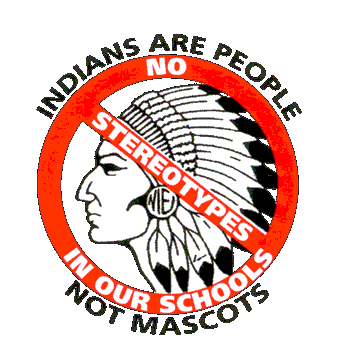
How should we decide what is offensive?
For this issue, I think the best way to deal with it is to base the decision off of the reactions of the public to the mascot. If the mascot is causing a lot of controversy in an area, I think that the best thing and the most respectful thing is to change the mascot or get rid of it. If there is no controversy then I don't necessarily think the mascot is an issue, a mascot is something schools and universities are really proud of and honor a lot. Unless people feel negatively targeted as Native Americans because of the mascot, there is no reason to get rid of it.
Tuesday, 20 September 2011
Breaking Down Stereotypes
1. "All Muslims are terrorists or sympathizers."
2. The source of this stereotype in America and generally in the rest of the Western World:
"The religion of Islam is not a religion of hatred and violence, but a religion of respect for all humans and God. This is the true Islam, the religion of equality, morality, and faith. The two major branches in Islam are the Sunni branch and the Shi’a. The Sunni Muslims make up a total of 80% of the Muslim population and they do adhere to the rules and regulations that have been explained. The Shi’a Muslims are a minority and the more radical branch of Islam. Unlike Sunni’s, Shi’a Muslims put much priority on jihad (to struggle and fight through and for Islam). Their interpretation of jihad permits them to be violent and sometimes harmful towards non-Muslims and some Muslims. Martyrs are also very much honored by Shi’a Muslims, mostly because Shi’as have a strong support for Ali, who was a martyr and Muhammad’s son-in-law. This strong belief in fighting for religion promotes much of the radicalism among Shi’a Muslims. Though they are a minority, Shi'a Muslims change other people's understanding of Sunni Muslims. Muslim immigration into America began in the 1960’s with a small population and became more evident as more Muslims immigrated to the U.S. Many Muslims immigrated for economic opportunities, education, and to escape wars, civil wars, and revolutions in the Islamic world. Non-Muslims were very welcoming towards the new Muslims and accepted their culture and way of life. Muslims had also added more diversity and culture to the American society and lived successfully in their new lives. Mosques and Islamic schools were opened, and Islam began to be an integral part of American life. However events like Jimmy Carter’s failure with Iran in 1979 and September 11th, 2001 have portrayed Islam negatively. Many non-Muslims began to wonder if Islam was truly a religion of peace. ...These minor misunderstanding slowly turned into serious hate crimes towards Muslims. Mosques and Islamic centers had been attacked and even torn down by angry non-Muslims. Muslims in the western world were persecuted physically and mentally because of the portrayal of Islam as a corrupt and antagonistic belief. Muslims have been usually considered as top suspects for terrorism in the western world. An example of this would be the Oklahoma City bombing on April 19, 1995 (Encyclopedia Britannica). Before investigators discovered that Timothy McVeigh and Terry Nichols were responsible for the attack, it was initially believed that the attack was organized by a group of Muslim terrorists. This information was displayed on several national television networks. Eventually, it was proven that the terrorist group was not involved with the bombings. Islam teaches Muslims to not support any Islamic terrorist in any way.Islam does not permit the murder of innocent people." (Hossain, Religious Tolerance).
Also, it is stated in the Quran,
"Fight in the cause of God against those who fight you, but do not transgress limits. God does not love transgressors."
3. Science cannot prove this stereotype; there is no scientific proof that even remotely makes sense. Logically, if people were to look at the facts and actually attempt to understand Islam as a religion instead of basing it off of stereotypes, word of mouth etc. then this stereotype would probably not be as present as it currently is today in the United States and many other countries. The stereotype can be broken down into a component of a misunderstanding of culture and history; it is based off of a past of warfare and one more radical group of Islam, the Shi’a Muslims, have been generalized as "all of Islam".
4. My direct experience proves to me the fictitiousness of this stereotype. To assume that all Muslims are terrorists or sympathizers is an uneducated, unfair thing to do, and I have countless personal experiences and I have met amazing people who are Muslims who have even further proved this to me.
5. All Muslims are not terrorists, nor are they all sympathizers.
Citation
Hossain, Semonti. "Islam Behind the Stereotypes." Religious Tolerance. 25 July 2004.
"Oklahoma City Bombing." Encyclopedia Britannica. 2003 edition. Web. 20 Sept. 2011.
Monday, 19 September 2011
How to Tear Down a Stereotype
- State the stereotype clearly and accurately
- Where does the stereotype come from?
- Use data to disprove or enlighten "facts"
- What is my personal experience?
- Revise and restate the stereotype
Subscribe to:
Posts (Atom)